






On 31st July 2025, hundreds of protesting IDPs blocked the Makurdi–Lafia expressway in Makurdi. Their message that morning was simple: there is hunger, neglect, and broken promises.

The protest came less than 24 hours after Nigeria’s First Lady, Oluremi Tinubu, visited Benue State and announced a ₦1 billion donation to support displaced persons following the Yelewata attack that claimed many lives.
For Mwuese Ugela, one of the protesters, the timing was not a coincidence.
“We heard in the news that the First Lady had given the Benue State Government ₦1 billion. And if we don’t protest, that money will never reach us. They have been doing this to us over and over,” she said.
Ms Ugela’s fears are not unfounded.

A detailed review of Benue State’s audited financial statements from 2018–2024, alongside the 2025 Budget Implementation Report published on the Open Nigerian States platform and the Benue State Budget and Economic Planning Commission site, which represents the government’s official record of actual expenditure, reveals troubling inconsistencies, unexplained gaps, and a pattern of fiscal decisions that appear to have compounded rather than alleviated the humanitarian crisis.
A History of Donations, A Pattern of Questions
Benue has, for many years, and under different administrations, witnessed different forms of fatal violence. Under the administration of Samuel Ortom, 2015 to 2023, Benue faced repeated waves of displacement due to violent attacks. Donations flowed in. And the state repeatedly budgeted funds for IDP-related interventions, but actual expenditures were often extremely low or poorly described.
 On 7 February 2018, the then Governor of Rivers State, Nyesom Wike, reportedly donated ₦200 million to support internally displaced persons (IDPs) in Benue State.
However, a closer examination of official financial records and subsequent statements reveals troubling inconsistencies that raise serious concerns about transparency and accountability.
A review of Benue State’s 2018 audited financial statements shows no clear evidence that the ₦200 million donation was recorded under capital receipts.
The absence of this entry immediately casts doubt on whether the funds were formally received, properly documented, or accurately reported within government accounts.
Yet, in November 2018, the then Executive Secretary of the Benue State Emergency Management Agency (SEMA), Emmanuel Shior, publicly confirmed that the funds had indeed been received and utilised.
“The ₦200 million donated by Rivers State Governor Nyesom Wike to cater for the IDPs has been judiciously utilised for the purpose it was meant. The money in question has been used in the procurement of food and non-food relief materials meant for their upkeep,” he said.
This assertion appears to directly contradict the state’s own audited financial report. In 2018, the state budgeted ₦50 million for “Rehabilitation of IDPs” by SEMA, but spent only ₦46 million. While this suggests moderate implementation, the recurrent expenditure line tagged “Welfare Packages” recorded only ₦328,000 in actual spending, an amount that is strikingly insignificant given the scale of displacement already affecting communities at the time.
This discrepancy raises a fundamental and unresolved question: if ₦200 million was received and “judiciously utilised,” why did the official records reflect only ₦50 million in expenditure? More critically, what happened to the remaining ₦150 million?
The gap between public declarations and audited figures points to a deeper issue: systemic weaknesses in financial reporting, oversight, and institutional accountability.

In 2019, despite ₦80 billion in the state’s total revenue from all sources, only ₦15,000 was recorded as capital expenditure on IDP welfare according to the 2019 audited financial statement.
₦15,000 — for IDP rehabilitation in a year marked by crisis!
Although ₦30 million was approved for the rehabilitation of IDPs, only ₦15,000 was reportedly spent. That represents an implementation rate of just 0.05 per cent.
In practical terms, the state almost entirely failed to utilise the allocated intervention funds despite continued attacks and displacement across rural communities.
This is despite the fact that Governor Ortom was known for appealing for assistance for IDPs, yet government spending on them remained minimal.
COVID-19 Provided the Only Clearly Defined IDP Intervention
The 2020 records stand out as one of the few years where expenditure descriptions were relatively specific.
The government reported ₦86.2 million under recurrent expenditure for “COVID-19 protective and relief materials for Internally Displaced Persons.” An additional ₦79.4 million was recorded, against an approved budget of ₦110 million.
However, even in that year, capital expenditure on “Rehabilitation of IDPs” remained low, with only ₦4.24 million spent against a budgeted ₦8 million.
This raises critical accountability questions. If the humanitarian situation was severe enough to justify emergency COVID-19 interventions for IDPs, why did long-term rehabilitation and resettlement spending remain minimal?
The Disappearance of IDP Spending in 2021 and 2022
Perhaps the most disturbing pattern emerges in 2021 and 2022.
The audited records show no actual expenditure on IDP-related capital projects in either year. In 2021, there were no reported recurrent or capital expenditure lines tied to IDPs.
In 2022, the state approved ₦800 million for “Welfare Packages” under recurrent expenditure, but actual spending recorded was zero. This is despite the states’ earned revenue of ₦80.8 billion in 2021 and ₦101.5 billion in 2022, respectively.
This occurred during a period when violent attacks, mass killings, and displacement continued across Benue communities.
Data obtained from the SBM Violence Tracker and the Foundation for Justice, Development & Peace of the Catholic Diocese of Makurdi report published in September 2025 showed that about 308 persons were killed in 2021 following attacks on several communities across the state. Media reports further indicated that, in a single attack on 23 May 2021, over 100 people were killed in Katsina-Ala Local Government Area.
Furthermore, the report also revealed that violence escalated further in 2022, with more than 335 people reportedly killed in attacks across several communities in Benue State. Media reports documented multiple deadly incidents during the year, including an attack in Agatu Local Government Area in which about 20 persons were killed, as well as other separate attacks across the state claiming 22 lives. Thousands of people were displaced in those attacks.
In September 2021, Governor Samuel Ortom publicly acknowledged that the crisis had “overstretched the resources of the state” and appealed for national support.
However, a careful review of the state’s audited financial reports for 2021 and 2022 reveals no clearly identifiable budget line or expenditure item relating to the welfare and support of internally displaced persons (IDPs).
This raises a critical question: if the audited reports do not provide clear records or descriptions of expenditures connected to the IDP crisis, on what financial basis did the state government conclude that the humanitarian situation had overstretched state resources?
The absence of expenditure details creates a credibility gap that weakens public trust and makes independent verification impossible.
In February 2022, former Vice President Atiku Abubakar reportedly donated ₦50 million to support internally displaced persons (IDPs) in Benue State. During the same period, a cleric, Apostle Johnson Suleiman, was also reported to have donated ₦20 million to the Benue State Government to provide welfare support and other basic needs for IDPs.
However, there was no independent confirmation that the state government officially received either donation, as neither amount was reflected in the capital receipts section of the 2022 audited financial report.
Furthermore, a detailed scrutiny of the Benue State audited reports for 2021 and 2022 revealed no identifiable line-item expenditure related to IDP welfare by the state government, including the State Emergency Management Agency (SEMA), the institution primarily responsible for the care and support of displaced persons in the state.
In August 2022, SEMA disclosed that Benue required approximately ₦500 million monthly to meet the basic needs of nearly two million displaced persons.
The contradiction is stark: public acknowledgement of crisis, appeals for funds, donations received and zero recorded expenditure.
One thing is clear: IDPs were not a fiscal priority. And the audited records raise critical questions:
How did a humanitarian crisis severe enough to prompt interstate and private donations attract virtually no financial response from the state government?
And how did IDP welfare fall to zero budgetary priority at the very moment government officials were warning that resources had been exhausted?
By 2023, the state had elected a new governor, as Catholic cleric Hyacinth Alia was sworn in on 29 May. This may have contributed to the state’s improved accounting pattern as it became a bit more transparent. It shifted from the absence of expenditure to large but vaguely categorised spending.
At the end of 2023, SEMA expenditure surged to ₦559,750,000 under “Welfare Packages,” nearly exhausting the approved ₦560 million budget.
Benue’s IDP Money Trail Ends Where Accountability Should Begin
An analysis of Benue State’s 2024 and 2025 budget implementation reports reveals a troubling pattern in the fiscal management of internally displaced persons (IDP) interventions: while the government clearly disclosed where billions of naira in humanitarian support came from, it failed to provide matching details on how the money was spent.
 In both years, the audited accounts included detailed actual capital receipts specifically tied to IDP support. The records identified funding sources, intervention agencies, and in some cases, the exact purpose of the assistance. In both years, the state government received more monetary donations than it expected.
In 2024 alone, the state recorded over ₦11 billion in IDP-related inflows. The 23 local governments contributed ₦2.79 billion for IDPs and disaster victims, while UNHCR provided ₦1.64 billion in cash interventions. ActionAid Nigeria accounted for ₦1.31 billion in food and cash assistance.
NEMA interventions included ₦1.38 billion for sewing machines, rice, and other items, as well as ₦500 million for grinding machines distributed to IDPs. The federal government also provided over ₦4.03 billion as emergency response funding.
The 2025-budget implementation report showed a similar pattern. BESEMA recorded over ₦8.9 billion in inflows tied to IDPs and disaster response. The accounts specifically described UNHCR interventions as “Financial Interventions to SEMA,” IOM support as “building of shelter for IDPs,” ActionAid support as “Food & Cash Interventions,” and Federal Government support as “relief materials food item donations to IDPs.”
But while the receipts side clearly explained the source and purpose of the interventions, the expenditure side largely failed to show how the funds were utilised.
 Questions Trail IDP Funds as Receipts Outpace Spending by Billions
An analysis of budget and expenditure records relating to Internally Displaced Persons (IDP)-tied funds reveals significant discrepancies between actual receipts and reported expenditures over the 2024 and 2025 fiscal years, raising questions about the management and utilisation of the funds.
In 2024, actual IDP-tied capital receipts amounted to N11.6 billion, exceeding the approved budget estimate of N10.4 billion. Despite this inflow, only N4.5 billion was reported as expenditure on IDP-related activities during the year. The figures leave an apparent balance of approximately N7.1 billion between receipts and reported spending.
The pattern continued in 2025. Actual IDP-tied capital receipts stood at N8.9 billion, significantly higher than the approved budget projection of N2.2 billion. However, total reported IDP-related expenditure for the year amounted to N10.3 billion, meaning the government spent more than it received to support IDPs.
A closer review of the 2025 expenditure profile reveals that N5.8 billion—more than half of total IDP-related spending—was allocated to administrative costs incurred by the Benue State Emergency Management Agency (BESEMA), while only N4.4 billion was spent directly on welfare packages and support services for displaced persons.
When the figures for both years are combined, actual IDP-tied capital receipts totalled approximately N20 billion. Of this amount, N8.9 billion was reportedly expended on welfare interventions for displaced persons, while N5.8 billion went to administrative expenses. Together, these expenditures account for about N14.7 billion, leaving approximately N5.8 billion unaccounted for in the records reviewed.
At the end of the 2024 fiscal year, the Benue State Government carried forward approximately N85 billion in unspent recurrent and capital funds into 2025. By the close of 2025, the amount carried forward had risen to about N128 billion into the 2026 fiscal year.
Against the backdrop of such substantial unspent balances, the persistent underfunding of welfare support for internally displaced persons presents a troubling contradiction. While billions of naira remained unutilised and were rolled over into subsequent fiscal years, direct spending on the welfare needs of displaced populations remained comparatively limited.
The figures raise important questions about budget priorities, expenditure decisions, and the transparency of funds specifically tied to addressing the humanitarian challenges facing thousands of displaced families across the state. They also highlight the need for greater public disclosure regarding the management of IDP-related revenues and expenditures.
What is clear, however, is that the available figures reveal a disconnect between the resources received in the name of displaced persons and the amounts ultimately spent on their welfare.
In 2024, projects meant for “Resettlement, Rehabilitation and Reintegration Projects for IDPs” and “Skills Acquisition and Provision of Starter Kits for 600 Female IDPs” recorded zero actual spending despite budgetary allocations.
“Welfare Packages” Become a Fiscal Black Box
In 2024, the only major spending entry linked to IDPs was a vague recurrent expenditure item called “Welfare Packages,” where over ₦4.5 billion was reportedly spent in a double-entry with the same code.
The accounts provided no breakdown of what the packages contained, who benefited, which communities were covered, or how the funds were distributed.
The same pattern appeared in 2025. The report recorded ₦4.47 billion under “Package Welfare” but failed to disclose detailed programme implementation, beneficiary records, procurement details, or project-specific expenditures for humanitarian interventions.
The contradiction exposes a major accountability gap: the government provided detailed records of who gave the money and why, but not detailed evidence of how the interventions translated into food, shelter, healthcare, rehabilitation, or direct support for displaced families.
The absence of a breakdown creates a significant accountability gap.
Financial accountability experts say such vague classifications undermine public transparency, particularly in humanitarian spending, where vulnerable populations depend on timely and targeted assistance.
The contradiction between massive inflows and weak clarity on expenditure also raises broader governance questions: if billions were received specifically for IDPs, why were rehabilitation, reintegration, and livelihood projects not implemented?
And why is the largest spending category described only as “Welfare Packages” without supporting details?
Ternugwa Azende, a chartered accountant and professor at Benue State University, Makurdi, and Timothy Agum, an auditor, observed that categorising over ₦4.5 billion as “welfare packages” without identifying the specific programmes funded or the beneficiaries reached raises serious accountability concerns.
According to Mr Azende, “welfare packages” do not disclose the actual nature of the expenditure, and that in itself is a red flag. “Vague descriptions like this can make such expenditures appear questionable and difficult to verify.”
The Invisible IDP in Capital Budgets
Despite rising welfare figures, the Budget Implementation Reports for 2024 and 2025 show that none of the 19 listed capital projects specifically mention IDPs.
There is no clearly itemised capital investment in camp infrastructure, healthcare facilities in camps, water systems, and long-term resettlement programs
In official accounting terms, the IDP crisis appears largely invisible in capital development planning.
Overall, between 2018 and 2025, across two administrations, the numbers tell two different stories — one of silence and one of surplus.
While Ortom’s administration may have used specific IDP- related expenditure descriptions, such as rehabilitation of IDPs in its capital expenditure. Both the Ortom and Alia administrations used the vague word ‘welfare packages’ as budget lines in IDP-related recurrent expenditure descriptions.
Reality in the Camps
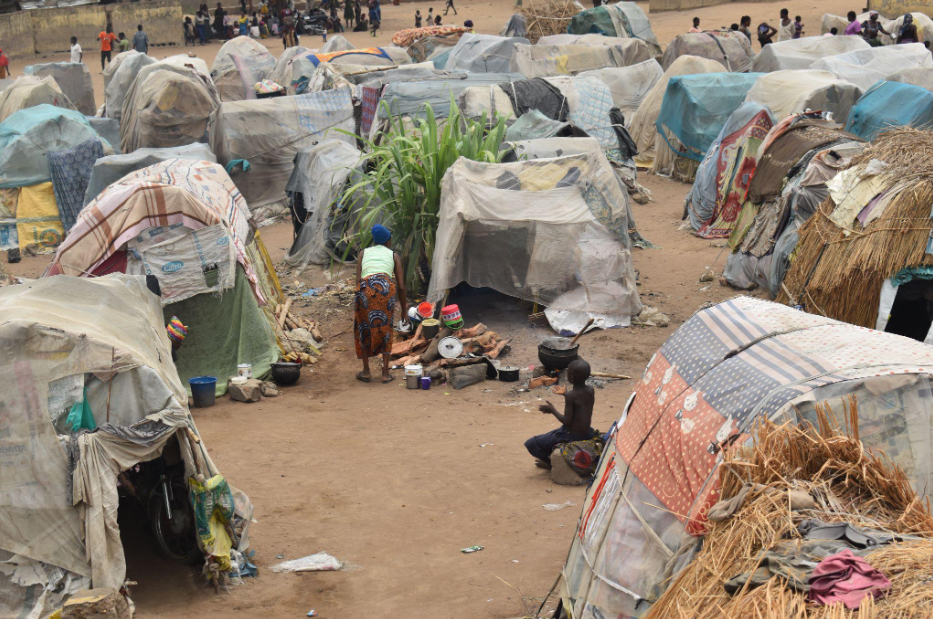
Amidst the limited and vague expenditure for the IDPs over eight years, the situation in the Benue camps remains an eyesore.
According to the Displacement Tracking Matrix (DTM) of the International Organisation for Migration, Benue has an estimated 480,000 IDPs.

Visits to camps reveal harsh realities.
In Makurdi, a camp housing over 13,000 people has no functional health facility. A clinic once supported by UNICEF is no longer operational.
A local NGO staff member disclosed that there is no functional health facility in any of the IDP camps across the state.
Comfort Orban, a mother of two residing in one of the camps, said:
“There is no functional clinic here. In 2025, UNICEF set one up, but since the start of this year (2026), it has not been operational.”
Access to safe water remains a pressing challenge in the camps. Most of the boreholes were drilled by humanitarian organisations rather than the state. During the dry season, several of them become non-functional, increasing pressure on the few that remain operational and deepening hardship for displaced families.

Food distribution is painfully irregular, and when it finally comes, it is barely enough to make a difference.
“We end up sharing just one mudu of rice, sometimes three at most, and that is after waiting three or four long months,” said Msendoo Tyokaa, her voice edged with frustration. “How can that sustain anyone, let alone a family of four?”
Across camps in Naka, Ugba, and Daudu, the story is the same. In host communities like Jato Aka in Kwande and Obagaji in Agatu LGA, displaced residents say survival often depends on the mercy of other NGOs or on finding casual labour in the host communities — carrying loads, working on farms, doing whatever small jobs they can find to afford a meal.
In Naka IDP camp, Iember Akosu, a mother of three who has lived in the camp for over seven years, said:
“It has been NGOs and humanitarian organisations that come to our aid. We barely get support from the government.”


One thing is conspicuously clear: international donors, such as the International Organisation for Migration and other humanitarian organisations, remain the most active actors in the camps.
Donor Relief, Governance Questions
Recently, in Naka, headquarters of Gwer West LGA, the contrast became even more pronounced.
Years after waves of violence displaced farming communities, thousands of IDPs and vulnerable host families continued to struggle for access to clean water, particularly during the dry season.
In February 2026, the European Union in Nigeria, alongside implementing partners, commissioned a 500,000-capacity water facility to serve both IDPs and host communities. The water project forms part of a ₦1.7 billion intervention package pledged by the EU in 2025 following the deadly Yelewata attack.


EU-funded water plant in Naka, Benue State, is part of a N1.7 billion intervention package
For residents of Naka, the project is lifesaving. But it also raises difficult questions.
Why did it take external intervention to provide basic water infrastructure in a local government that received more than ₦22 billion in FAAC allocations between 2018 and 2025, according to Federal Account Allocation Committee (FAAC) disbursement records published by the Office of the Accountant-General of the Federation and made available through the National Bureau of Statistics?
Financial records indicate that in 2025 alone, Gwer-West local government received approximately ₦5 billion in FAAC revenue. Yet IDPs in these areas have lived in neglect for years.
This stark contrast highlights a governance paradox: local revenues are available, yet essential public services for the displaced populations remain underfunded or poorly managed.
The reliance on donor interventions underscores systemic fiscal inefficiency and weak accountability, where internally generated funds fail to translate into meaningful development.
The absence of detailed disclosures makes it impossible to independently verify whether the billions reportedly spent translated into improved living conditions for IDPs. This opacity creates an accountability vacuum that enables waste, misallocation, or potential diversion of public funds.
The problem is not about one administration; it reflects a deeper, systemic failure of public financial management — weak oversight of SEMA, poor budget discipline, and the absence of performance-based humanitarian spending.
This fiscal breakdown entrenches the IDP crisis by leaving camps chronically underfunded at moments of urgent need, fostering dependence on irregular donations and emergency appeals, and creating fertile ground for diversion and mismanagement when large allocations are eventually released.
Humanitarian Crisis Managed Without Measurable Outcomes
Across the eight-year period, the records also reveal three persistent accountability failures in the management of internally displaced person (IDP)-related funds.

First, despite clear evidence of IDP-specific cash inflows and detailed records documenting the intended purpose of these funds, the actual expenditure reports failed to explain how the funds were spent.
Second, the repeated use of vague expenditure descriptions, such as “Welfare Packages,” served as an umbrella label that concealed the actual destination and impact of billions of naira in public spending.
Third, there was a glaring absence of outcome-based reporting. The audited statements provided no measurable indicators such as the number of shelters constructed, camps rehabilitated, livelihoods restored, or beneficiaries reached.
The Accountability Gap
The financial records suggest that Benue’s IDP crisis is not only a humanitarian emergency but also a fiscal transparency problem. The issue is not merely whether money was allocated. The deeper concern is whether public expenditure can be independently traced, verified, and connected to actual relief outcomes.
Where billions are spent without detailed disclosures, procurement transparency, or evidence of beneficiaries, humanitarian accounting risks become a fiscal blind spot.
Fiscal accountability failure in Benue State is not only reflected in missing or opaque expenditure records but also in the inability of the government’s own audited accounts to clearly demonstrate how IDP-targeted funds translated into actual welfare interventions for displaced populations.
The central question raised by the records remains unanswered:
How can billions be spent in the name of IDP welfare while audited accounts provide so little evidence of what the displaced actually received?
This report was commissioned with support from the Center for Journalism Innovation and Development (CJID) under a journalism initiative funded by the Royal Norwegian Embassy