







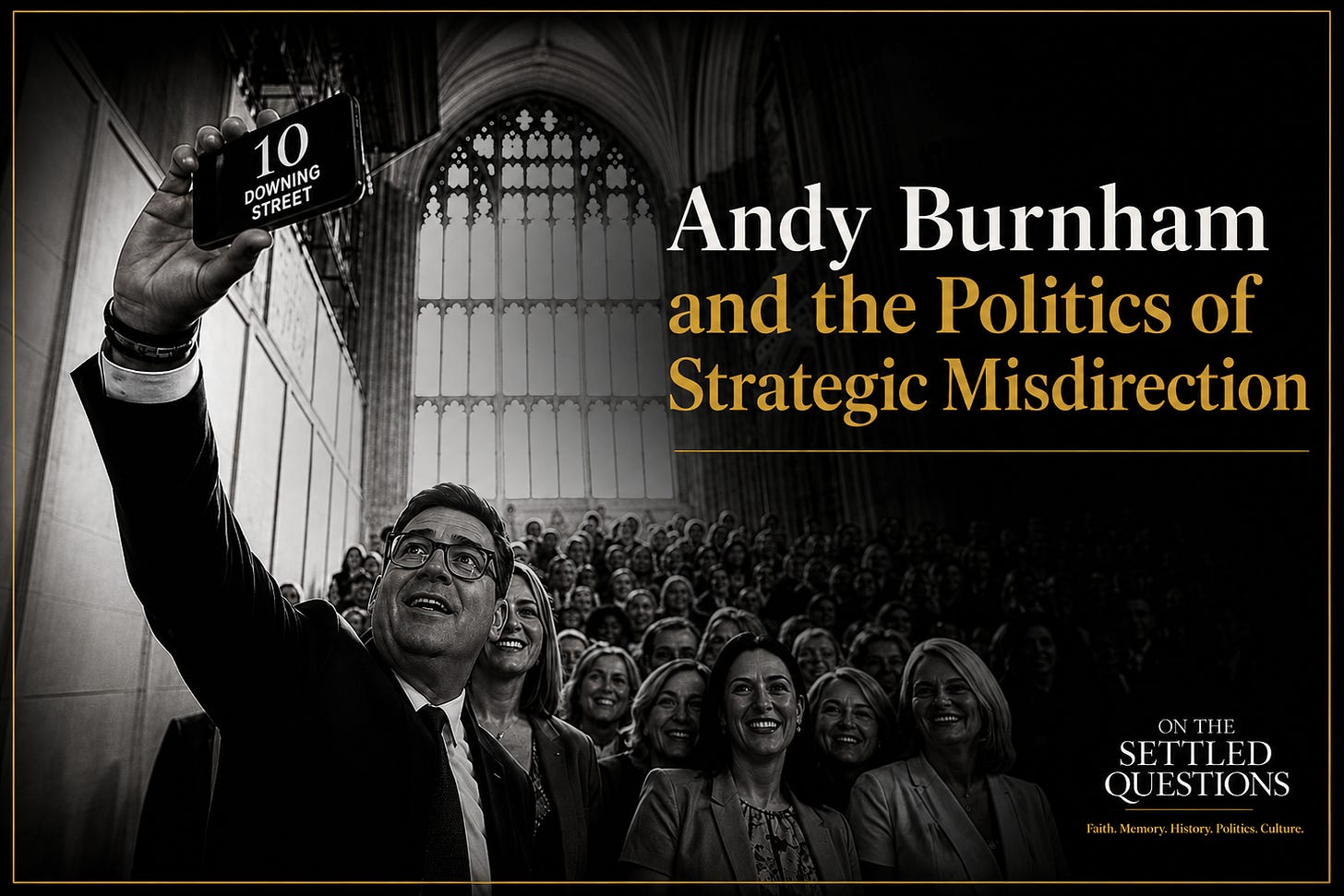
Every political age has to address unavoidable, uncomfortable realities. Modern Britain, rather than suppressing awkward questions, increasingly redirects attention towards constitutional reform, administrative restructuring and regulatory revamps, whilst leaving the underlying problems largely untouched. Andy Burnham’s proposals, captured in the banner “Number Ten of the North”, provide an illuminating case study in strategic misdirection.
Two years ago, in Peering into the Labour Abyss, I predicted the following for the future Starmer Government:
“…he has had a great deal of time to think about how he will complete the Blair revolution: the goal being to wield executive power, ensuring the unaccountable Cathedral of academia, sanctioned media, public sector quangocracies, police, & courts enforce a permanent legislative revolution – making future elections irrelevant…In the end, this will be an open class war. On one side, the ruling leftist institutional leaders, with their hedge-fund globalist think tanks, and young leaders, stamping down on the aspirant, patriotic, normal, excluded working class and socially conservative-leaning middle classes. Given the array of unworkable policies, it will be a social, economic, and political car crash.”
The country has been surveying the car crash and has already issued its verdict: widespread rejection of Labour and Starmer in successive May local, Welsh, and Scottish elections. Yet rather than confronting the urgent questions faced on the doorstep, or acknowledging the Starmer policy double-downs that made matters worse, politicians are convinced it is not the policies that are wrong and need to be reversed, but their execution and location.
Rather than unpack and dismantle the legal and treaty obligations that prevent us from removing foreign illegal entrants who commit serious crimes, we are told the Government will “smash the gangs”. It is an abstraction that has not stemmed the flow, even as the number of sexual assaults and assailants rises. Even the BBC, the purveyor of acceptable opinion, appears to have noticed how porous our borders have become.
The immediate problems Starmer inherited remain as they were, or have worsened on his watch. Still, Andy Burnham now seeks to open a new conversation about the style, substance and geography of governance.
Brown, Blair and Burnham’s Solution
The governance debate inside Labour is not simply a dispute between left and right, or between old Labour and New Labour, but between rival explanations for why the British state no longer seems able to act effectively. The deeper backdrop is social precarity: debt, housing shortage, welfare dependency, failing infrastructure, unrepaired pot holes in most streets, social fragmentation, mass net immigration, sectarian tension and the collapse of confidence in public administration. These are not isolated policy failures but a collective failure, often a product of the bipartisan policy prescriptions we are still wedded to.
Gordon Brown’s answer is moral and constitutional. Britain, in his view, has become over-centralised, territorially unjust and insufficiently solidaristic. The answer is to renew the Union, disperse power, strengthen nations and regions, and restore a social settlement in which poverty, housing insecurity and regional decline are treated as failures of collective obligation. Brown wants to re-legitimise the state. He sees destitution before dependency, broken solidarity before fiscal exhaustion, and constitutional imbalance before civilisational decline.
Blair’s answer is executive and technocratic. He does not begin with the romance of devolution, nor with Brown’s moral language of solidarity, but with delivery. The state must become more capable, technologically advanced, data-driven and productive. Housing requires supply, planning reform and economic realism. Welfare requires redesign, not simply more money. Immigration requires control, though Blair remains instinctively globalist. Jihadist extremism, for him, is ideological and must be confronted as such. Blair wants to re-engineer the state.
Burnham stands between them: Like Brown, he distrusts Westminster centralisation. Like Blair, he admires visible executive action. But his real instinct is municipal: transport, housing, skills, employers, procurement and public services gathered around place and directed by mayoral authority.
Brown decentralises legitimacy. Blair modernises delivery. Burnham municipalises power.
Yet all three remain, in different ways, captured by the machinery of government. They ask how Britain should be governed, administered, digitised or devolved. The harder question is whether the underlying social, fiscal, demographic, and cultural model that they and the Conservative governments that preceded and followed them into power can even be sustained at all.
The Relocation Illusion and Administrative Class.
Burnham’s recent proposals have already attracted detailed and measured criticism. More interesting, however, is what the programme leaves untouched. The first is the need for urgent action. Moving officials from Whitehall to Manchester does not necessarily transfer power from London to the North. Hybrid working and digital government have made physical location increasingly irrelevant. Authority lies not in office buildings but in decision-making structures, and elected councillors exercise local accountability.
Moreover, house prices and disposable income have slowly segregated our cities. Christophe Guilluy, in Twilight of the Elites: Prosperity, the Periphery, and the Future of France, analysed these changes in Paris. In particular, he identified a traditional elite of civil servants and industrialists merging with a new upper-middle class known as bobos — bourgeois-bohèmes — professionals in media, technology, culture and higher education who thrive in the globalised economy.
They espouse cosmopolitan, progressive and multicultural values, the rhetoric of the “open society”, whilst benefiting from economic arrangements that increase inequality. Despite their inclusivity, Guilluy argues, they practise residential separatism. They gentrify city centres, drive up property prices and send their children to private or high-performing state schools, creating an educational apartheid that excludes the working class.
They rely on low-wage immigrant labour whilst remaining socially distant from both immigrant communities and the native working class. The immigrant class is trapped in social housing. In contrast, the traditional working class is gradually forced to the periphery, on long commutes into the city, competing with immigrant surplus labour that has lower transport overhead.
Consolidating, Not Devolving, Power Across the Country
This social class talks to itself via much of our media, BBC Radio 4 and its flagship Today Programme, the Spectator and New Statesman talking-head panels on YouTube, and, yes, in the Parliament speeches and regional assemblies. Dominic Cummings has highlighted genuine problems at the heart of government in the social class itself that he sees as intellectually substandard and riddled with incompetence and policy stagnation.
But it is this social class that is consolidating its power across the country rather than sharing it Even when officials are persuaded to migrate, or are replaced by newly appointed post holders, it will still be memders fo this addmistrative class nd its “bobo” hangers on, the senior civil servants, legal advocates, consultants, civil servants, academics and media types — with politicians like Burnham convening them — who will exercise or rather squander power.
London’s Kensington and Chelsea, Westminster and Richmond upon Thames postcodes will be exchanged for Manchester’s Castlefield and Deansgate, City Centre North and Collyhurst, New Islington South and Bradford. Yes, a step down for relocators, but house prices will rise; please be patient.
Relocating departments, therefore, risks becoming little more than administrative theatre. It produces announcements, photographs and ribbon-cutting ceremonies whilst leaving the social machinery of government substantially unchanged. Nor does experience suggest that bureaucracies become smaller.
Existing institutions are rarely abolished. They are reorganised, duplicated and rebadged. Such relocations come with early retirement and redundancy settlements, relocation expenses and inducements for those who move. They will not take weeks. They will take years, cost hundreds of millions, and still barely be ready to go before the next election.
Britain is repeatedly told that elected mayors, combined authorities and regional assemblies bring power closer to ordinary people. Yet local government has itself been hollowed out by decades of financial pressure. Parish, district, borough and shire councils have been weakened, whilst another administrative layer has emerged between Westminster and genuinely local democracy. The language speaks of devolution; the institutional reality often points towards further centralisation.
The election of independent and more recently Reform Party insurgent candidates, ousting conservative and Labour council strongholds and even becoming the majority party in major councils, is usually followed by a rude awakening as they come to see that the core of the council’s business, the statutory requirements, the spending expectations and legal requirements are all determined in Whitehall.
Growth, Prosperity, and Precarity
The same strategic misdirection appears in economics. Prosperity is increasingly presented as something governments create through programmes, investment, long-term planning, stakeholder cooperation and public spending. In reality, governments can only create conditions in which prosperity may emerge.
Wealth comes from productive businesses, investment, entrepreneurship, innovation and work. Healthy economies generate tax revenues; governments do not spend societies into lasting prosperity. Strategic misdirection shifts focus from enterprise to administration, while overregulation, planning restrictions, and high costs push investors and innovators elsewhere.
Whenever politics disappoints, the answer is no longer to change, reverse, or radically reform policies, but to redesign governance: another authority, another commission, another inquiry, another independent commissioner, and another quango. Parliament may indeed have weakened, but further weakening of representative institutions is no remedy. Democratic legitimacy ultimately rests upon public consent rather than administrative expertise. The public is now increasingly living from paycheck to precarious paycheck.
An Undemocratic Establishment Coup.
The striking feature of Burnham’s proposals is therefore not what they contain but what they ignore. Hotfoot from canvassing and campaigning in his Makerfield constituency, we can now see he was not really listening to the electorate. Could he be borrowing the Scottish National Party’s tactic of claiming policy success whilst blaming failure on the Westminster system?
Voters have not, in recent elections, demanded another constitutional settlement. They have asked why taxes continue to rise, why gas and electricity bills are among the highest in Europe, why immigration remains at a historically high level, why running a business is becoming impossible, why housing has become less affordable, and why public services appear to be simultaneously more expensive and less effective.
Strategic misdirection may prove one of the defining characteristics of this political era. Failed policies are seldom abandoned; they become surrounded by constitutional redesign, managerial language and institutional innovation until public attention shifts elsewhere. Constitutional choreography cannot indefinitely conceal political failure.
When the dust has settled, and the coronation of the Burnham elevation to Number Ten takes place, it will have been an undemocratic political coup for the social class of unelected aristocrats. Keir Starmer won his parliamentary seat of Holborn and St Pancras in 2024 with a mere 18,884 votes, but was installed in Downing Street by 9,708,716 Labour voters and a deeply divided opposition.
Andy Burnham won Makerfield with 24,927 votes, but has no electoral mandate for his change agenda. If he imagines otherwise, he will face a rude awakening. Either way, there will be no honeymoon period.
The next series of policy, economic, and geopolitical car crashes is already piling up.