




The remarkable performance of African teams at the 2026 FIFA World Cup is expected to translate into millions of dollars in prize money and club compensation, with football stakeholders urging Nigeria to learn from the continent’s historic success after the Super Eagles failed to qualify for the tournament.
President and Chief Executive Officer of Tabic Sports Agency, Mr. Pascal Atuma, said the qualification of nine African nations for the Round of 32 represents not only a sporting milestone but also a significant economic opportunity capable of transforming football development across the continent.
Atuma, a FIFA-licensed football agent, sports entrepreneur and movie producer, said the unprecedented success of African teams at the expanded 48-team tournament underscores the rewards of sound football administration, long-term planning and strategic investment.
According to him, beyond the on-field achievements, the financial rewards accruing to the qualified countries, their football federations and domestic clubs should serve as a wake-up call for football administrators across Africa, particularly in Nigeria.
“Remember, the ten African teams that qualified for this year’s FIFA World Cup were already guaranteed $9 million each simply for participating in the group stage. Now, with nine African teams advancing to the Round of 32, each of those federations will receive an additional $10 million, plus $2.5 million upfront to cover training camps, travel and delegation expenses.
“It then means that each of those nine countries will take home $12.5 million at this stage alone. You see, these are life-changing revenues that can transform football development if managed properly,” Atuma said.
He further noted that the financial gains extend beyond national football associations through FIFA’s expanded Club Benefits Programme, under which clubs are compensated for releasing players to represent their countries at the World Cup.
“We tend to overlook another major financial gain in this showpiece which is FIFA’s Club Benefits Programme. At this 2026 FIFA World Cup, FIFA is paying clubs a minimum of $5,000 per day for every player released to the tournament as part of the expanded $355 million Club Benefits Programme.
“What this means is that local clubs like Ghana’s Accra Hearts of Oak, whose goalkeeper Benjamin Asare is Ghana’s first-choice goalkeeper now, as well as Medeama SC and Nations FC with one selected player each, are each guaranteed nothing less than $100,000 for now because this is already about the 19th day of the World Cup.
“Egyptian clubs will also benefit with 15 home-based players, South Africa have 19, Morocco included one, Algeria two, and even Tunisia, despite failing to progress, had six home-based players in their World Cup squad. These are direct financial rewards flowing back into local football, strengthening clubs and encouraging youth development,” he said.
Atuma described Nigeria’s absence from the tournament as a costly failure whose implications go far beyond missing out on football’s biggest stage.
“It is painful to imagine honestly speaking. That kind of money could improve infrastructure, youth academies, player welfare and the overall sports economy in Nigeria.”
He said Nigeria, with its vast football talent and pedigree, should never have been absent from a World Cup of this magnitude.
“A country blessed with enormous football talent and regarded as the most populous Black nation in the world failed to qualify for a tournament where African football is making history. It’s quite unfortunate to say the least and going forward it should be a moment of sober reflection for our football administrators.”
While congratulating the nine African countries that progressed to the knockout rounds, Atuma attributed their achievements to effective planning, sound administration and strategic investment.
“The success of these countries has shown that Africa is no longer just participating at the World Cup. We are competing, progressing and earning unprecedented financial returns and hopefully, Nigeria learns from this experience and returns stronger, because our football heritage deserves to be represented on the biggest stage in world football,” he added.
Nine African nations—Morocco, South Africa, Egypt, Ghana, Senegal, Côte d’Ivoire, DR Congo, Algeria and Cape Verde—qualified for the Round of 32, marking Africa’s strongest collective performance at a FIFA World Cup.
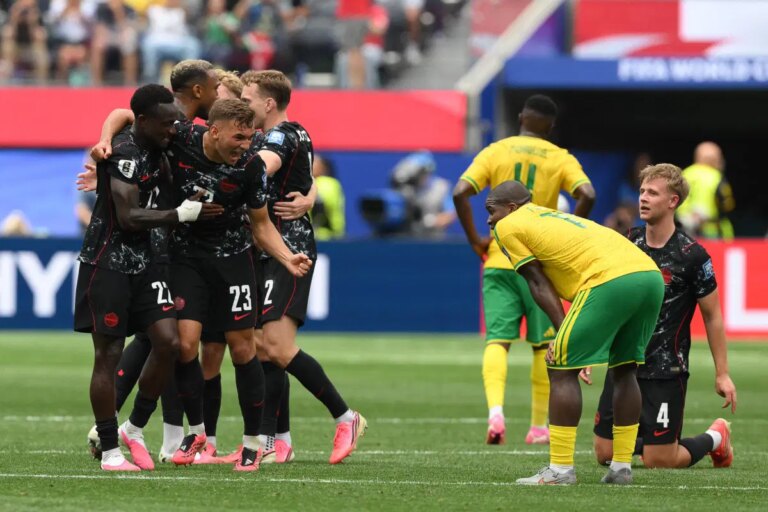
The knockout phase begins with South Africa facing co-hosts Canada in California. Other African fixtures include Morocco against the Netherlands and Côte d’Ivoire versus Norway on Tuesday, DR Congo against England and Senegal versus Belgium on Wednesday, while Algeria will face Switzerland, Egypt take on Australia and Cape Verde meet defending champions Argentina on Friday.