



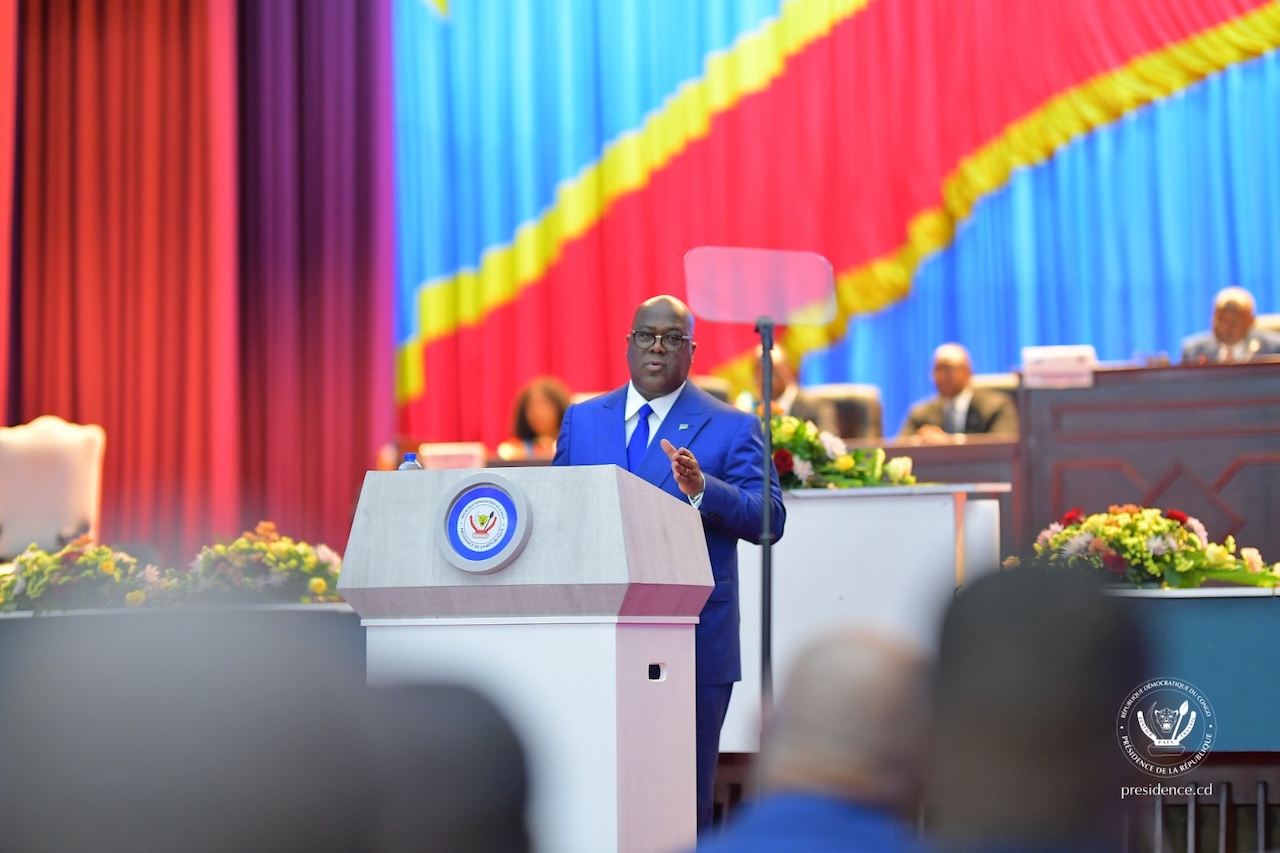

On 15 June, the Democratic Republic of the Congo (DRC) Senate adopted a constitutional revision bill that would effectively reset presidential term limits. If enacted, the bill would enable a referendum on a new constitution under which President Félix Tshisekedi’s previous terms would not count, clearing the way for a third term.
The DRC’s constitution prohibits revision of term limits, but this bill allows Mr Tshisekedi to initiate constitutional change. Its adoption follows his 6 May statement that elections could not take place in 2028 unless the eastern DRC conflict was resolved, and that he would be open to a third term “if the people want it.”
Despite protests against the bill, the process continues. These developments have fuelled concerns about what opposition members call a ‘constitutional coup.’
Since Mr Tshisekedi’s coalition dominates Parliament, the review process is advancing faster than opposition parties and civil society can fight it. The Coalition of Congolese for Constitutional Change and the Catholic Church – through the National Episcopal Conference of Congo – oppose it. But neither has the institutional clout to halt constitutional reform. Their influence lies more in mobilising public pressure and influencing how external actors respond to DRC developments.
The distinction matters because constitutional legitimacy has consequences beyond domestic politics. This became evident when former president Joseph Kabila’s delayed departure from office triggered not just protests in the DRC but a legitimacy crisis that weakened Kinshasa’s diplomatic position regionally and globally. When public trust in the electoral process declined, so did Kinshasa’s ability to garner international support.

Mr Tshisekedi’s constitutional tinkering could become self-defeating, with consequences that extend beyond diplomacy. Rather than strengthening the state’s ability to confront conflict, postponing elections under the guise of security would further weaken already fragile governance. Years of weak institutions, corruption and the eastern DRC conflict have undercut public confidence in the state, with only 12% of the population expressing trust in electoral processes.
A referendum and a conditional electoral cycle would exacerbate fragility in two key ways.
First, low public trust undermines the credibility of democratic processes, increasing the likelihood that election outcomes are seen as manipulated rather than representative. Political competition shifts away from institutional channels, encouraging citizens and political actors to seek alternative forms of mobilisation, including support for armed groups.
Second, continued violence in eastern DRC creates an environment in which political contestation is easily securitised. Armed groups and political elites may exploit fear, mistrust and uncertainty to justify violence or carry out retaliatory attacks, while the government risks being seen as either incapable of maintaining constitutional order or complicit in undermining it. This further weakens fragile state institutions and deepens societal divisions.
A primary concern for the DRC is that the proposed constitutional changes will reproduce patterns of past political instability. A state facing profound security challenges depends on legitimate institutions to maintain public trust and manage political competition peacefully. Weakening those institutions in the name of security is likely to generate greater instability rather than resolve it.
Despite military operations, states of siege and regional deployments, Kinshasa has struggled to reverse the gains of the Alliance Fleuve Congo (AFC)/M23. Its more effective strategy has been internationalising the conflict. United Nations (UN) investigations, sanctions, regional mediation initiatives and increasing Western pressure have all helped highlight Rwanda’s support for the rebellion.
The DRC has consistently framed the conflict as an act of external aggression against a sovereign state. And although the conflict is widely viewed as a culmination of both internal and external issues, Mr Tshisekedi’s constitutional manoeuvring risks complicating Kinshasa’s diplomatic messaging. Rather than defending allegations of support for the rebellion, Rwanda can now highlight Kinshasa’s political tensions and constitutional controversy, complicating the DRC’s efforts to maintain a clear, consistent message.
Whether that argument is convincing is almost beside the point. International diplomacy is less a contest between truth and falsehood and more a contest between competing narratives. A president seeking to reset term limits and delay elections provides Rwanda with a narrative that complicates Kinshasa’s own.
Internationally, a range of responses could unfold. European governments and multilateral institutions have previously emphasised the need for constitutional governance and democratic norms in DRC. For them, attempts to extend presidential tenure could raise difficult questions about Mr Tshisekedi’s political legitimacy.
By contrast, US engagement is driven less by democratic principles than by strategic interests, including regional stability and critical mineral supply chains. The partnership risks giving Mr Tshisekedi additional political backing, as Washington abandons any pretence of favouring democratic or state reforms in its transactional and extractive foreign policy.
Kinshasa’s declining democratic legitimacy would also strengthen the AFC/M23’s long-standing demands for autonomy and hybrid governance by reinforcing the claim that the central government does not represent all Congolese. In the current political and security landscape, a referendum on a new constitution would exclude civilians living in rebel-held territories, casting further doubt on the inclusiveness and legitimacy of the process.
Breaking cycles of violence and aggression will require sovereignty premised on both internal legitimacy and external backing, enabling dialogue and reforms that address the conflict’s structural drivers.
Averting the outcome of Mr Tshisekedi’s constitutional manoeuvring requires action now, not after the process closes. The Catholic Church and civil society coalitions remain among the DRC’s most influential domestic actors, and their role in promoting dialogue and public debate should be supported through ongoing engagement and capacity building. The focus should be on ensuring that credible domestic voices are consistently included in national conversations on constitutional reform.
Regional and multilateral actors, including the East African Community, International Conference on the Great Lakes Region and the UN, should strengthen coordination of existing mediation and early warning mechanisms to prepare for preventive engagement if tensions escalate.
International partners engaged in DRC peace processes must clarify the conditions attached to their support. Diplomatic backing, including pressure on Kigali, cannot be decoupled from Kinshasa’s constitutional conduct.
Kinshasa cannot afford to fight two legitimacy battles at once: one against Rwanda in eastern Congo and another over constitutional succession at home.
Nirvaly Mooloo is a Research Officer, and Remadji Hoinathy is a Senior Researcher on Central Africa and Lake Chad Basin ISS.
(This article was first published by ISS Today, a Premium Times syndication partner. We have their permission to republish).