






By Vincent Ujumadu
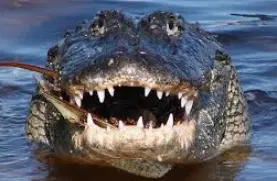
OBEAGWE is a riverine community in Ogbaru local government area of Anambra State. It has a unique culture which has not been abandoned despite modernity. In this community, the people revere the Alligator, a semi-aquatic animal which they believe protects them and wards off external aggressors when necessary.
The people are mainly farmers and fishermen, and it is one of the food baskets of Anambra State. In Obeagwe, alligators could be seen moving around in the compounds, and nobody dares to harm them.
To many people in the nine villages that make up Obeagwe community, their continued existence could be traced to the presence of the alligator in the days of their forefathers who had neither the guns nor the influence needed to confront those who fought hard to take over the community by force.
A leader in the community, Chief Emeka Awogu, said that because Obeagwe is a small community, some of its neighbours attempted to annex it, but the people resisted.
The matter, he added, went to the court and the case lasted for many years, adding that many people could not send their children to school because they were contributing so much to fight for the sovereignty of the community.
Awogu said: “The matter even went up to the Supreme Court where our community eventually won. In spite of the court decision, some of our neighbours are still trespassing on our farmlands, although it has reduced to the stage where families fight for what belongs to them.
“Even some people from Abor in the present Delta State wanted to wage war against us because they wanted to come and live here, but our gods protected us. Our fathers told us how Abor could take off from their area on canoes for the purpose of coming to fight our people, but because the community is fully protected by the gods, they would always pass Obeagwe without seeing the community, only to realise that they had passed when they got close to Atani town.
“This continued to happen until they became tired and lost hope of annexing our community. If they had landed on our land then, they would have driven us out of our community because their population is much larger than ours.
“Our forefathers who fought the battle said that what was protecting our people was a deity called Osa Obeagwe, which originally belonged to one village in Obeagwe, but was later adopted by the entire community. Alligator is worshipped in Obeagwe because our people believe that it protects them.”
According to Awogu, before, the alligator could enter people’s houses, and no one dared to harm them.
“Our people are not known to visit native doctors, but they believe that once they visit the shrine dedicated to the alligator, no harm could come to them. As far as Obeagwe is concerned, we accord so much respect to the alligator,” he stated.
To promote the culture of the people and thank the gods for being good to them, they celebrate Ulo, an annual festival usually marked after the planting season.
Throughout the period of the festival, which lasts for five days, it is eating and drinking galore, and people can enter any home and join in the eating.
Awogu said the most popular drink used during the festival is the locally brewed gin. “Eating is done in groups, and people mingle from place to place enjoying themselves. On the final day, he said, visitors don’t sleep in our community as custom demands, as that period of the celebration lasts throughout the night.
He added that every three years, the festival is capped with the appearance of the Onoli masquerade, which dances from one end of the community to the other, with people following it excitedly as it waves to them.
“Our people return to witness the Onoli masquerade from all parts of the country to rejoice with their people at home that the planting season is over.