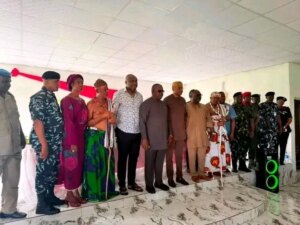







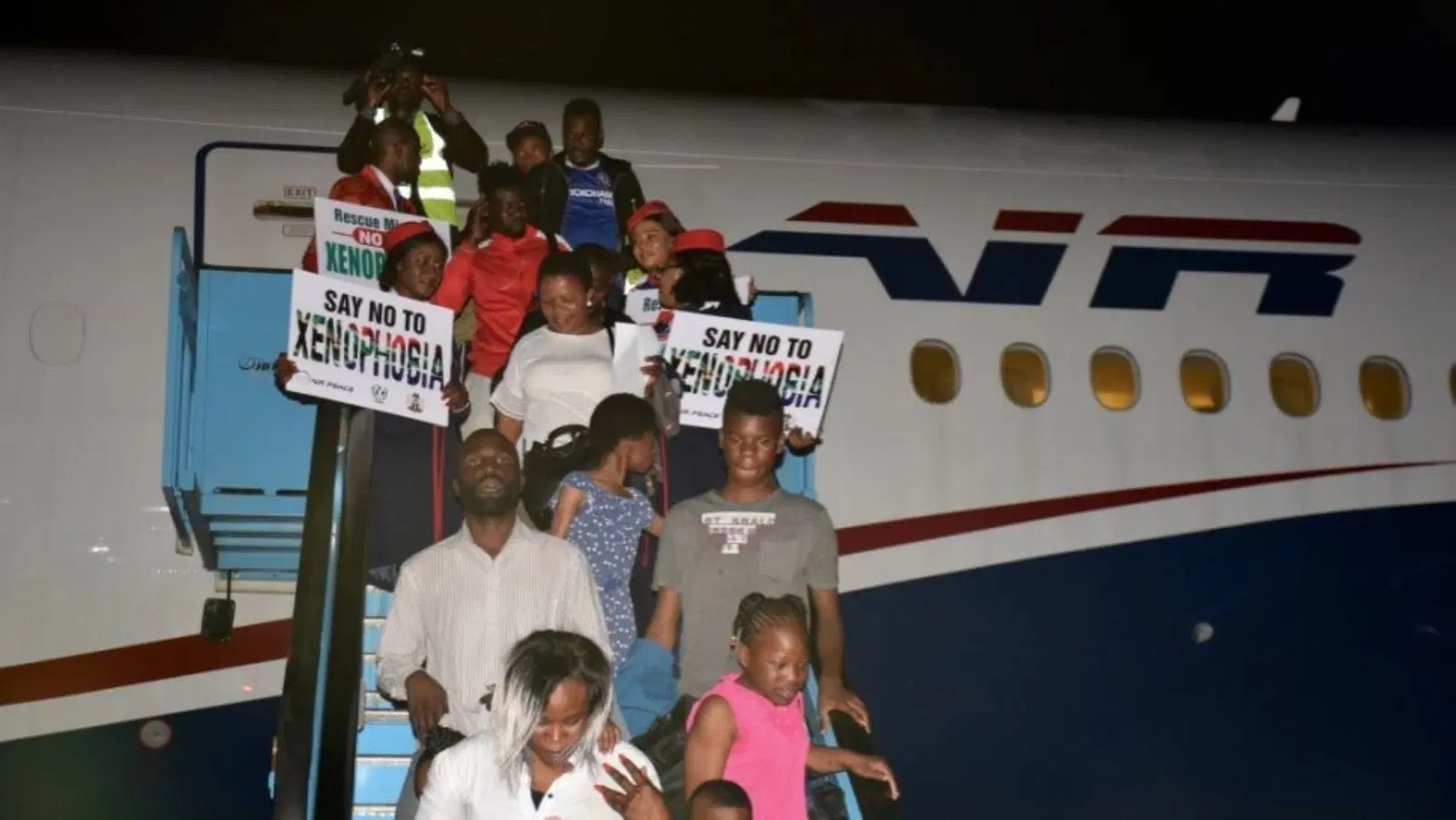
File image of some returnees.
•FG profiles 1,000, promises skills training, trauma counselling
By Dickson Omobola & Matilda Ikediobi
Federal Government has said its agencies are committed to the reintegration of Nigerians who voluntarily returned from South Africa through livelihood support, skills acquisition programmes, psychosocial and mental health counselling to help them recover from the trauma they experienced.
Read Also: Video: ‘They vowed to shoot remaining Africans’ — Nigerians recount ordeal in South Africa
It also disclosed that more than 1,000 returnees had been profiled, adding that there had been bilateral engagements between governments of Nigeria and South Africa to ensure the safety of Nigerians living in South Africa.
Director of the Migration Affairs Department at the National Commission for Refugees, Migrants and Internally Displaced Persons, NCFRMI, Ambassador Catherine Udida, spoke as Air Peace completed its third evacuation mission from South Africa, bringing home another 268 Nigerians, who arrived at the cargo terminal of the Murtala Muhammed International Airport, Ikeja, Lagos, Friday.
She said: “Federal government has made adequate arrangements for them through different agencies and ministries. There is NEMA, NiDcom, FAAN, NIS, with individual roles and responsibilities. The National Emergency Management Agency, NEMA, is providing the vehicles to transport the returnees to their respective states or nearby destinations, while the National Commission for Refugees, Migrants and IDPs is the lead agency responsible for their return. So, we are providing durable solutions.
“That means we will provide livelihood support, skills, training and, of course, psychosocial and mental health counselling because of the trauma they have experienced. Currently, we have profiled more than 1,000 persons, and they have all been adequately catered to. There have been bilateral engagements between governments of Nigeria and South Africa. So far, there has been continuous engagement to ensure the safety of all Nigerians in South Africa.”
Meanwhile, the returnees, who spoke to Vanguard, recounted losing businesses worth millions of Naira and battling the stigma of being labelled criminals.
Speaking to Vanguard, Babatunde Oladeji said: “I lived in South Africa for two decades. Every foreign national experiences xenophobia. If it is not traumatising, it leaves you with nothing. Many people have lost their homes, properties and everything they worked for. I don’t think it is xenophobia; it is Afrophobia. They only have problems with African migrants. I saw Americans who were there on visits, but they never had such experiences. It is always Africans.
“I didn’t like what I saw. My purpose for going to South Africa was never realised because everything was shattered. I lost my business. I lost everything. I ran a security and cleaning company, which was hijacked. I lost more than 1.5 million rand. They looted me and used my details for fraudulent purposes. At the end of the day, I found myself living in poverty. The perception they have of Nigerians is terrible; they see every Nigerian as a criminal. I was not an illegal immigrant, but we were all painted with the same brush. I don’t know where I will go with my family now that I am back. I have to start all over again.”
Also sharing his experience, Fola Kester said: “I have been in South Africa since I was four. I’m now 21. I haven’t been able to get my papers. I made an initial application, but it was lost in the system. And once you have applied without getting a response, you can’t apply again. My dad tried to reach the Department of Home Affairs, but there was no response. I was in university and completed my first year, but I could not register for subsequent years because of my papers.
“After exhausting all my options, including hiring lawyers and sending emails to Home Affairs, I had to leave because I didn’t have a life in South Africa. I couldn’t live like a normal person because I had no access to anything. There has been nothing but silence from Home Affairs. I was fortunate not to live in areas where xenophobic attacks occurred, but I heard about such experiences.”
Meanwhile, Obi, a returnee from Anambra State, said: “I will urge Nigerians not to have anything to do with South Africa because they don’t like us. Once you mention that you are Nigerian, they immediately develop hatred towards you. This isn’t the first time. It is political because whenever elections are around the corner, they do this. They assume that every black foreign national in South Africa is Nigerian.”